> ## Content Index
> Fetch the complete content index at: https://articles.akadata.co.uk/llms.txt
> Use this file to discover other available public pages before exploring further.
# Routing with Open vSwitch in Routed Mode (with Pre-NAT Hop)
- URL: https://articles.akadata.co.uk/routing-with-open-vswitch-in-routed-mode-with-pre-nat-hop/
- Published: 2025-05-19T14:01:38.000Z
- Updated: 2025-05-19T14:12:06.000Z
- Author: AKADATA
# Routing with Open vSwitch in Routed Mode (with Pre-NAT Hop)
This guide outlines a practical and effective way to route traffic through an Open vSwitch (OVS) setup in a routed network topology, where virtual machines (VMs) on one subnet are forwarded through an intermediate router (host) to a NAT gateway.
## 🔧 Scenario
- **VM Subnet**: `172.20.1.0/24` (routed via `homer`)
- **LAN Subnet**: `172.16.0.0/24` (on `worker`, which performs NAT)
- **Public interface**: `enp6s0` on `worker` (dynamic IP, NAT target)
- **Goal**: Allow VMs to reach the internet via an OVS bridge and NAT on another machine
## 🏗️ Network Architecture
```
[Windows VM] ──> [OVS bridge: vmnetwork1] ──> [homer] ──> [OVS bridge: office1] ──> [worker: NAT] ──> Internet
```
## 🛠️ Key Components
- Open vSwitch bridges: `vmnetwork1` and `office1`
- Interfaces:
- `vmnet1` (added automatically by virt-manager)
- `mgmt1` (homer LAN-side port)
- `ens6`, `enp6s0` on `worker` (LAN + WAN)
---
## 1\. Configure OVS Bridges
### On `homer`:
```
ovs-vsctl add-br vmnetwork1
# vmnet1 is automatically added by virt-manager; do not add manually
ovs-vsctl add-br office1
ovs-vsctl add-port office1 enp6s0
ovs-vsctl add-port office1 mgmt1 -- set interface mgmt1 type=internal
```
```
admin@homer:/home/admin# ovs-vsctl show
da8fa1c2-936b-4e3b-b198-a76353b8dd34
Bridge office1
Port mgmt1
Interface mgmt1
type: internal
Port office1
Interface office1
type: internal
Port enp6s0
Interface enp6s0
Bridge vmnetwork1
Port vmnet1
Interface vmnet1
type: internal
Port vmnetwork1
Interface vmnetwork1
type: internal
ovs_version: "3.3.0"
```
## 2\. Set IP Addresses on `homer`
```
ip addr add 172.20.1.1/24 dev mgmt1
ip addr add 172.16.0.5/24 dev mgmt1
ip link set mgmt1 up
```
## 3\. Enable Routing on `homer`
```
echo 1 > /proc/sys/net/ipv4/ip_forward
```
And persist in `/etc/sysctl.d/99-forward.conf`:
```
net.ipv4.ip_forward=1
```
## 4\. `nftables` on `homer`
```
chain forward {
type filter hook forward priority 0;
policy drop;
ip saddr 172.20.1.0/24 ip daddr 172.16.0.0/24 accept
ip saddr 172.16.0.0/24 ip daddr 172.20.1.0/24 accept
ip saddr 172.20.1.0/24 oif mgmt1 accept
ct state established,related accept
}
```
## 5\. Routing/NAT on `worker`
### Enable forwarding:
```
echo 1 > /proc/sys/net/ipv4/ip_forward
```
### `nftables` Full nftables config on worker
```
#!/usr/sbin/nft -f
flush ruleset
# Filter Table
table inet filter {
chain input {
type filter hook input priority 0;
policy drop;
iif lo accept
ct state invalid drop
tcp flags & (fin|syn|rst|psh|ack|urg) == (fin|syn|rst|psh|ack|urg) drop
tcp flags == 0x00 drop
ip frag-off & 0x1fff != 0 drop
ct state established,related accept
iif ens6 ip protocol icmp accept
iif enp6s0 ip protocol icmp accept
iif ens6 accept
iif enp6s0 ip daddr != { 172.16.0.0/24, 172.20.1.0/24, 172.21.1.0/24 } tcp dport { 80, 443 } ct state new limit rate 25/second accept
ip saddr { 172.16.0.0/24, 172.20.1.0/24, 172.21.1.0/24 } oif enp6s0 accept
}
chain forward {
type filter hook forward priority 0;
policy drop;
ct state established,related accept
iif ens6 oif enp6s0 accept
iif enp6s0 oif ens6 ct state established,related accept
ip saddr 172.20.1.0/24 oif enp6s0 log prefix "VM→WAN: " accept
ip saddr 172.16.0.0/24 oif enp6s0 log prefix "LAN→WAN: " accept
ip saddr { 172.16.0.0/24, 172.20.1.0/24, 172.21.1.0/24 } oif enp6s0 accept
}
chain output {
type filter hook output priority 0;
policy accept;
}
}
# NAT Table
table ip nat {
chain prerouting {
type nat hook prerouting priority -100;
ip saddr { 172.16.0.0/24, 172.20.1.0/24, 172.21.1.0/24 } ip daddr 80.0.130.164 dnat to 172.16.0.1
ip saddr { 172.16.0.0/24, 172.20.1.0/24, 172.21.1.0/24 } log prefix "PREROUTING-NAT: " accept
}
chain postrouting {
type nat hook postrouting priority 100;
ip saddr { 172.16.0.0/24, 172.20.1.0/24, 172.21.1.0/24 } oif enp6s0 masquerade
ip saddr { 172.16.0.0/24, 172.20.1.0/24, 172.21.1.0/24 } oif enp6s0 log prefix "POSTROUTING-NAT: " accept
}
}
```
### `nftables` NAT:
```
chain postrouting {
type nat hook postrouting priority 100;
ip saddr { 172.16.0.0/24, 172.20.1.0/24 } oif enp6s0 masquerade
}
```
### `nftables` Full nftables config on worker
```bash
#!/usr/sbin/nft -f
flush ruleset
table inet filter {
chain input {
type filter hook input priority 0;
policy drop;
# Allow established/related
ct state established,related accept
# Allow loopback
iif lo accept
# Allow SSH (adjust as needed)
tcp dport 22 accept
# Allow ICMP
ip protocol icmp accept
ip6 nexthdr icmpv6 accept
}
chain forward {
type filter hook forward priority 0;
policy drop;
# Allow VM ↔ LAN routing
ip saddr 172.20.1.0/24 ip daddr 172.16.0.0/24 accept
ip saddr 172.16.0.0/24 ip daddr 172.20.1.0/24 accept
# Allow VM subnet to route to WAN via mgmt1
ip saddr 172.20.1.0/24 oif mgmt1 accept
ip saddr 172.20.1.0/24 oif mgmt1 log prefix "HOMER-DROP: " drop
# Allow established/related flows
ct state established,related accept
}
chain output {
type filter hook output priority 0;
policy accept;
}
}
```
###
## 6\. Configure Virt-Manager and XML Network
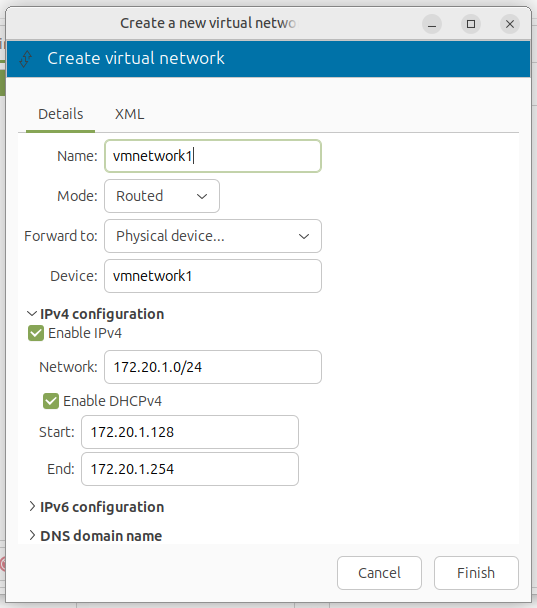
To integrate this network with `virt-manager`, define a routed virtual network using the following XML example:
```
vmnetwork1
ec8d7631-18b8-454b-b506-73ac2ff66202
```
Use `virsh net-define` and `virsh net-start` to enable it. Avoid naming conflicts with default networks like `virbr0`.
## 7\. Configure VM (Windows)
Set default gateway to `172.20.1.1` (homer).
Add static route for LAN access if needed: (in validation we ended up not needing it)
```
route -p add 172.16.0.0 mask 255.255.255.0 172.20.1.1
```
---
## ✅ Testing
Setup Virt-Manager to use the new network
### Step 1
### Step 2 - review
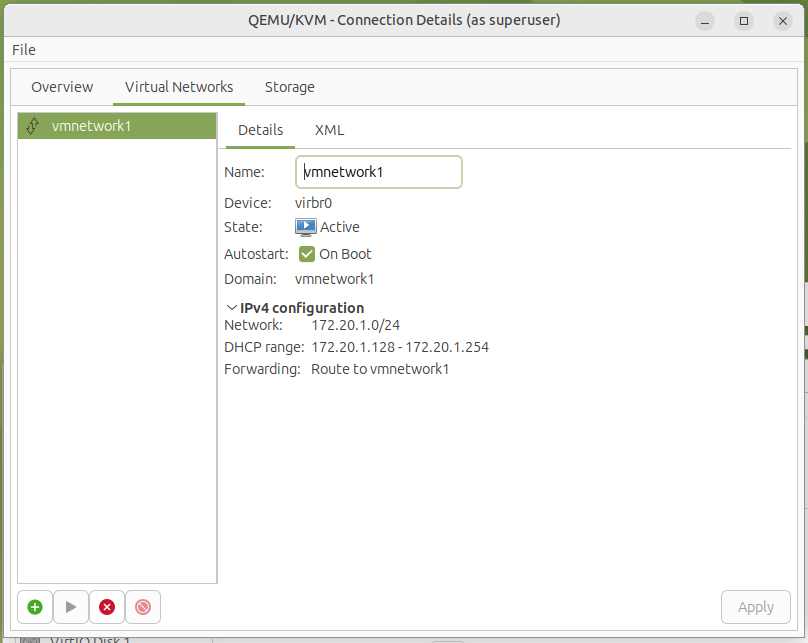
Or manually create a network
```
VM Network1 Name
```
Use the following commands to define and start the network:
```
virsh net-define /path/to/vmnetwork1.xml
virsh net-autostart vmnetwork1
virsh net-start vmnetwork1
```
This will register the network with libvirt, enable autostart, and bring it online for use in virt-manager. Avoid naming conflicts with default networks like `virbr0`.
---
## ✅ Validation
- `ping 172.16.0.1` (worker LAN IP) ✅
- `ping 8.8.8.8` or `tracert` from VM ✅
- `tcpdump` and `journalctl` used to trace NAT and route drops
```
C:\Users\akadata>tracert google.com
Tracing route to google.com [142.250.187.206]
over a maximum of 30 hops:
1 <1 ms <1 ms <1 ms 172.20.1.1
2 <1 ms <1 ms <1 ms 172.16.0.1
3 * * * Request timed out.
4 8 ms 9 ms 10 ms 80.255.193.212
5 * * * Request timed out.
6 17 ms 20 ms 20 ms eislou2-ic-3-ae0-0.network.virginmedia.net [94.174.238.226]
7 19 ms 17 ms 17 ms 72.14.221.42
8 20 ms 19 ms 18 ms 192.178.97.179
9 20 ms 19 ms 21 ms 142.251.54.33
10 24 ms 22 ms 19 ms lhr25s33-in-f14.1e100.net [142.250.187.206]
Trace complete.
```
## 🧠 Notes
- This setup keeps VM routing clean and offloads NAT to a robust external host.
- Split DNS and internal `.lab` domains can easily follow this foundation.
- Logging temporary `log prefix` rules in `nftables` is invaluable during setup.
---
## 🔮 Future Enhancements
- Add `vmnetwork0` bridge on `worker` to **segregate VM traffic** from the LAN.
- Implement split-horizon DNS using `.lab` for internal services.
- Add `dnsmasq` or `unbound` to serve `.lab` zone only over internal interfaces.
- Consider enabling `radvd` for IPv6 delegation to VMs if desired.
- Introduce firewall zone tagging and VLAN separation per interface role.